
High-level summary
- Translates a long career into a single defensible specialism.
- Gives recruiters and hiring managers a reason to fight for you internally.
Convert broad experience into a sharp market-ready story. Easier to understand, easier to remember, easier to recommend.
“The market does not buy a career history. It buys relevance, evidence and confidence in the problem you can solve.”
Without sharp positioning, every downstream asset is forced to do positioning's job badly. Recruiters and hiring managers fill the gap with their own assumptions — usually a smaller role than you deserve.
Cost of skipping it
Practical resources that turn this stage into action. Free tools open after a short email unlock.
20-question diagnostic across all six stages.
Pressure-test whether to move, reshape or stay.
Map your career direction using the Ikigai framework.
Assess your current career clarity and next priorities.
Structure your career discovery with targeted questions.
Learn the foundational principles for lasting career growth.
Confirm whether Positioning is your most urgent constraint. If it is, book a Career Diagnosis or step into the relevant Career OS™ programme.
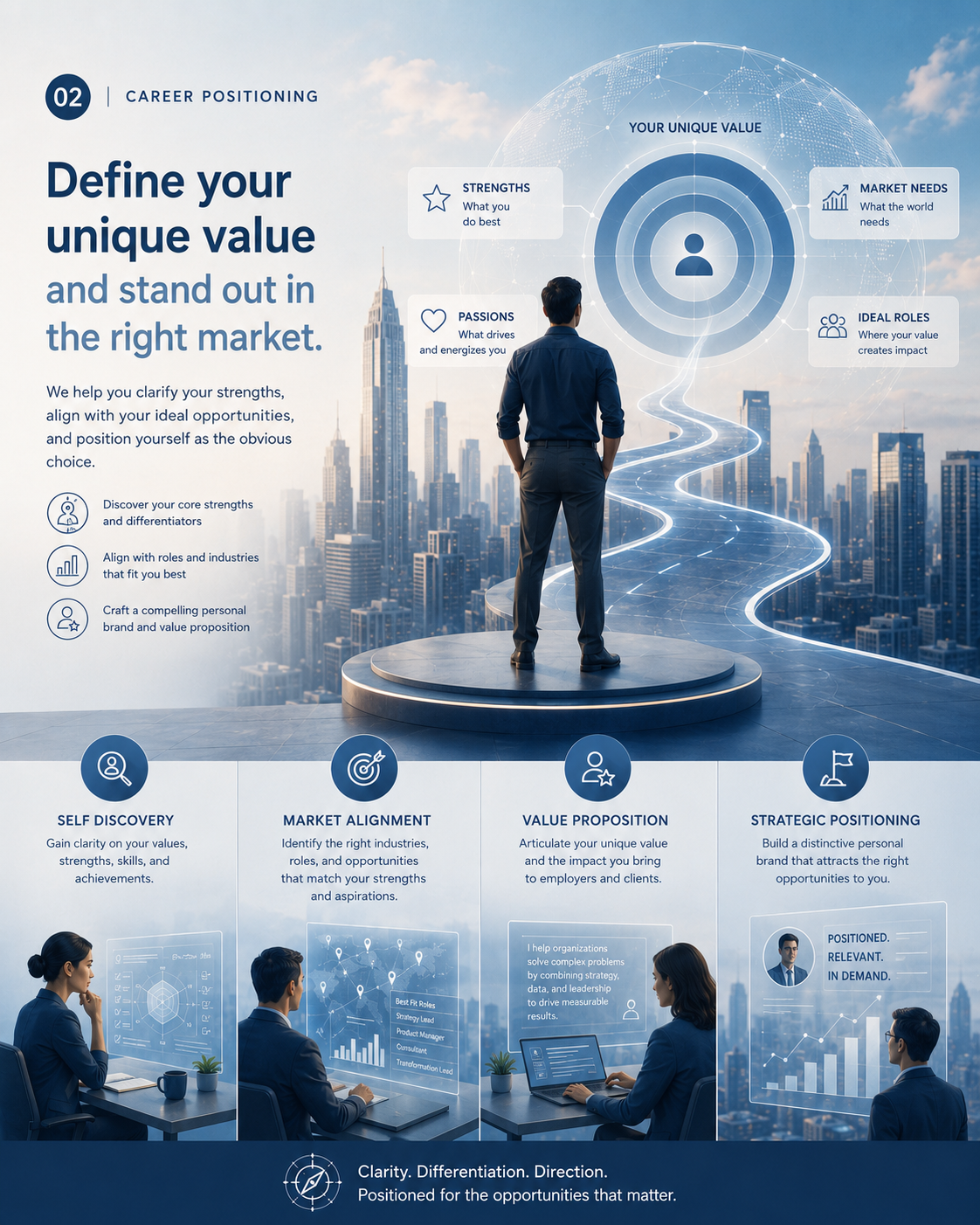
Positioning Strategy defines how the market should understand your value. Senior STEM professionals are rarely rejected because they lack experience — they are rejected because their value is not positioned clearly enough.
It turns your background, experience and capability into a clear professional proposition that answers one central question: why should this employer choose you for this level of role, now?
Technical careers are built through competence and delivery. That works inside organisations where people see the work. It does not automatically work in the external market — recruiters, hiring managers and AI screening systems only see the message you present.
Many technical professionals describe what they were responsible for, but not what they are known for, what value they create, or what senior problem they solve.
The most common mistakes include:
Positioning is built around four questions:
Initial: "I am an experienced engineering manager with strong technical and people management skills."
Repositioned: "Engineering delivery leader with experience leading cross-functional teams, supplier networks and complex technical programmes from concept through launch, with a track record of improving delivery confidence, reducing risk and aligning engineering execution with business outcomes."
The second version gives the market a clearer reason to care.
Write a one-sentence positioning statement: "I help [type of organisation] solve [type of problem] by applying [capability] to deliver [measurable or strategic outcome]."
If the sentence feels vague, your positioning needs more work.
Positioning is only convincing when backed by proof:
If you are a STEM professional with strong experience but inconsistent interviews, unclear positioning or stalled progression, Career OS™ gives you a structured way to diagnose the issue and rebuild your route to better roles. Book a Career OS™ Diagnosis Call — understand where your career system is leaking value, and what to fix first.